

OUR BLOG
Explained Simply: Understanding the Stud Pull Test on Tile Adhesives
Updated : 2 months ago
Have you ever wondered how companies check if the tile adhesive used in your home is strong enough? How do they know that the tiles on your floor or wall will not fall off after a few months?
There is a simple science test for this, called the stud pull test. Today, let's understand this test in a very easy way, just like explaining it to a small kid.
What is the Stud Pull Test?
The stud pull test (also called the pull-out test) is a standard method used to check the strength of adhesives for tile. In simple words, it tells us how much force is needed to pull apart two things that are stuck together - like a tile and the wall it is glued to.
This test gives us a proper number, in force units, so we can compare one tile adhesive with another and know which one is stronger.
How Does the Test Work? Step by Step
Let's break it down into easy steps, just like a recipe:
Step 1: Cleaning the Surface First, the surface is lightly rubbed with sandpaper and cleaned properly. This is done so that nothing dirty comes in the way, and the test fixture sticks well.
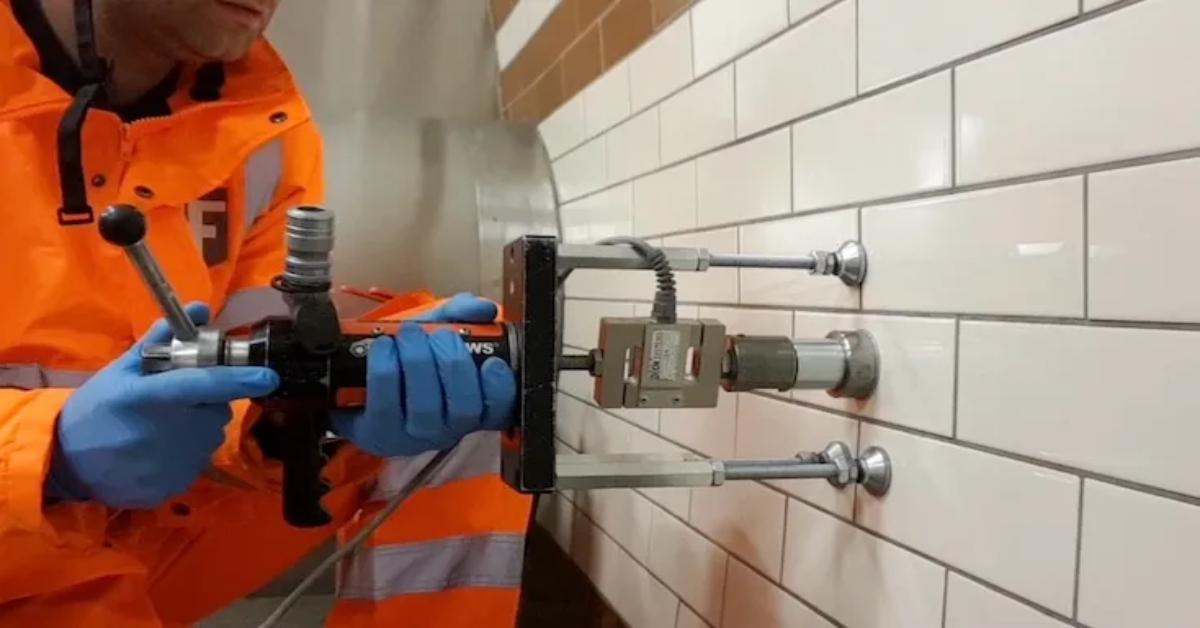
Step 2: Attaching the Fixture A small metal piece, called a dolly or stud, is stuck onto the clean surface. It is attached using a very strong glue (usually a two-part epoxy) which is even stronger than the tile adhesive being tested. This way, we make sure that when something breaks, it is not this attaching glue that breaks first.
Step 3: Pulling the Fixture Now comes the main part. A special machine, called a portable adhesion tester, slowly pulls the stud straight up and away from the surface. The machine keeps increasing the force until the stud finally comes off. The machine notes down the highest force used - this is our answer.
Step 4: Checking How It Broke After the stud comes off, experts look closely at where exactly it broke. There are three places where it could break:
Between the tile adhesive and the wall – this is called adhesive failure
Inside the adhesive layer itself – this is called cohesive failure
Between the fixture and the glue – this is called glue failure
By looking at where the break happened, experts learn a lot about the quality of the adhesive for tiles.
The 5 Types of Tile Adhesives (As per IS 15477:2019)
Not all tile adhesives are the same. In India, there is a rule book called IS 15477:2019, which divides tile adhesives into 5 types, depending on where and how they are used.
Type 1 Adhesive
Used for tiles that soak up more water (more than 3% porosity), like clay tiles or normal non-vitrified tiles. This type is only used inside the house, in dry areas.
Type 2 Adhesive
Used for tiles that soak up very little water (3% or less), like vitrified tiles, glass mosaic, or big-size tiles. This one can be used inside as well as outside the house, even in wet areas like bathrooms.
Type 3 Adhesive
Used for ceramic, clay, basalt, and natural stone tiles, but specially for outside walls of the building.
Type 4 Adhesive
Used when tiles or stones are fixed on drywall boards, like gypsum board, plywood, or fiber cement board, instead of a normal brick wall.
Type 5 Adhesive
Used for tiles and engineered stones fixed on metal surfaces or different types of cement-based surfaces. This type has special synthetic resin and mineral fillers mixed in it, which gives extra strong sticking power.
Why Does All This Matter?
When you are buying adhesives for tile for your home, office, or any building, it is important to pick the right type. Using the wrong type of adhesive can make the tiles come loose over time, especially in wet places or outside walls, where water and weather can be harsh.
The stud pull test, along with the rules given in IS 15477:2019, helps manufacturers and buyers make sure that the tile adhesive being used is strong, safe, and fit for its purpose — whether it is for your bathroom floor, your building's outside wall, or a stone counter on a metal frame.
So next time someone talks about adhesive for tiles, you will know exactly how its strength is tested, and which type is right for which job!
Where to find the best adhesives under one roof? The answer is RachTR that offers a range of adhesives with all ‘Types’:
RachTR ECO - Type 1
RachTR ECO+ - Type 2
RachTR ST – TYPE 3
RachTR PR - Type 4
RachTR Adflex - Type 5
The 5 Types of Tile Adhesives (IS 15477:2019)
Type 1: For porous tiles (clay/non-vitrified) in dry indoor areas only.
Type 2: For low-porosity tiles (vitrified/ceramic) in wet or dry areas, indoors and outdoors.
Type 3: For natural stone and tiles on exterior walls (weather & UV resistant).
Type 4: For drywalls and lightweight surfaces (plywood, gypsum, or fiber cement boards).
Type 5: For challenging surfaces (metal, glass, or engineered stone) that need high flexibility.
Buy your type today – know more by visiting the website https://www.rachtr.com/.

60 views
60
0 comments
0

GET IN TOUCH
RachTR Chemicals Private Limited, 4th Floor, Unit No 413/414, Spaze Boulevard, Above Kia Showroom, Sector 47, Gurgaon - 122018
© 2024 RachTR. All Rights Reserved.


Comments