

OUR BLOG
Understanding Statuario Marble Epoxy Solutions: Technical Parameters Explained
Updated : 1 month ago

Statuario marble is prized for its bright white background and bold, sweeping grey veining - but that same brightness is what makes it so unforgiving to repair. A statuario marble epoxy solution has to do more than just fill a crack; it has to disappear into the stone without shifting its colour, clarity, or vein pattern, today or ten years from now. This guide walks through the technical parameters that actually matter when selecting a marble epoxy resin system for Statuario, and where RachTR's resin range fits into that decision.
Why Statuario Marble Needs a Specialized Epoxy System
Statuario's high whiteness and semi-translucency mean it behaves almost like a lens - any resin used in its veins, hairline cracks, or pinholes is visible not just for its colour, but for how it interacts with light passing through the stone. Generic, uncontrolled epoxy systems are a common cause of two visible defects over time:
Yellowing - most standard epoxy resins contain aromatic components that oxidise under UV exposure, turning a pale amber-yellow that is stark against Statuario's cool white base.
Grey staining - resins with poor wetting or incompatible fillers can migrate slightly into the surrounding calcite, leaving a dull grey halo around the repair line.
Because Statuario is typically processed as large-format slabs and book-matched panels for premium applications, a resin failure isn't a small cosmetic issue - it's a slab-level loss. This is why fabricators working with Statuario tend to standardise on non-yellowing epoxy for statuario rather than treating resin selection as interchangeable across marble types.
For fabricators looking to standardise their crack-repair process, RachTR's Resin Line & Crack Repairing Systems covers the full range built for exactly this kind of application.
Key Technical Parameters to Evaluate Before Choosing an Epoxy
Before comparing specific products, it helps to know what to actually look for on a technical data sheet. These are the parameters that determine whether a marble epoxy resin technical data sheet is describing a system suited to Statuario:
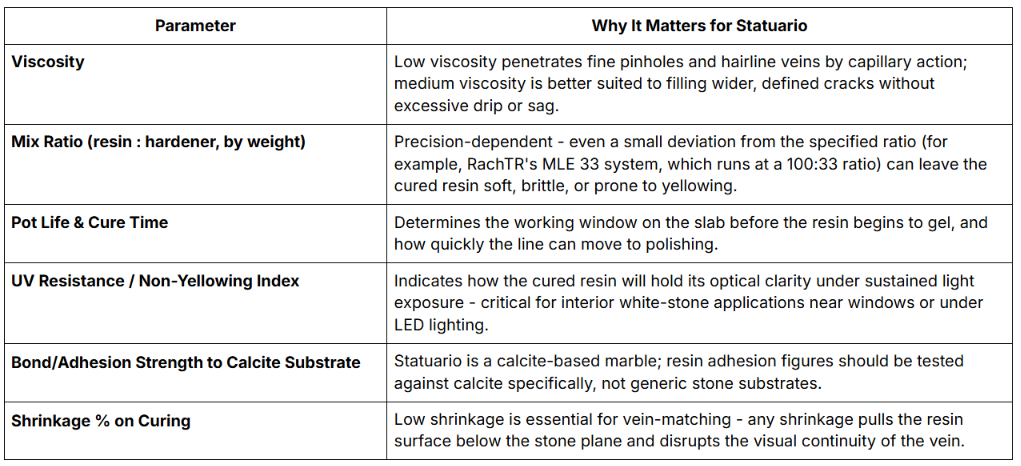
Reading a low viscosity marble epoxy TDS against this checklist - rather than just comparing price - is what separates a repair that holds up for years from one that needs to be reworked.
RachTR Epoxy Systems Suited for Statuario Marble
RachTR offers three resin systems that address different points in the Statuario repair and processing workflow:
RLE 31 - A solvent-free, medium-viscosity, UV-resistant, non-yellowing system built for automated resin-line application. Best suited to production lines processing Statuario slabs at volume, where consistency across every slab matters as much as the finish on any single one.
MLE 35 - A bleeding-free, high-adhesion, non-yellowing resin designed for manual crack filling. This is the go-to choice for fabricators hand-finishing individual slabs, bookmatched panels, or addressing isolated cracks and pinholes discovered during quality inspection.
NE 25 - Formulated for fiber-net-supported repairs on structurally fragile, book-matched slabs, where the resin needs to work in tandem with a mesh backing to hold the stone together during processing and transport.
In practice: RLE 31 for automated resin-line application, MLE 35 for manual, precision crack filling, and NE 25 where the slab itself needs structural reinforcement alongside cosmetic repair.
Step-by-Step Application Process
Substrate preparation - Clean the crack, vein, or pinhole thoroughly, removing dust and loose particles; ensure the surface is completely dry before resin contact.
Mixing - Weigh resin and hardener precisely to the specified ratio (never by volume or visual estimate); mix slowly to avoid introducing air bubbles.
Application - Apply the mixed resin into the defect using a spatula or applicator suited to the viscosity grade, working it fully into pinholes and hairline cracks.
Levelling - Remove excess resin from the surface while it is still workable, keeping the fill flush with the surrounding stone plane.
Curing - Allow the resin to cure undisturbed for the manufacturer-specified time before any further handling or movement of the slab.
Polishing - Once fully cured, polish the repaired area to restore surface gloss and blend the resin optically into the surrounding marble.
Inspection - Check under raking light for any visible resin lines, shrinkage dips, or colour mismatch before the slab is cleared for the next process stage.
Conclusion
Choosing the right statuario marble epoxy solution comes down to matching viscosity, mix precision, UV stability, and shrinkage behaviour to how and where the repair will be made - not just picking whatever resin is on hand. Whether your workflow calls for automated resin-line application, manual crack filling, or fiber-net-supported repair on fragile slabs, RachTR's resin systems are built around these technical parameters from the ground up.
For technical data sheets or help selecting the right system for your production line, get in touch with RachTR. To explore the full range of stone processing solutions, visit the Stone Processing Industry page.
FAQs
What viscosity epoxy is best for Statuario marble?
Low-viscosity resins are generally preferred for pinholes and hairline veins, where capillary penetration matters most. Medium-viscosity systems work better for wider, more defined cracks that need to be filled and held without sagging.
Does epoxy resin yellow on white marble over time?
Standard epoxy formulations can yellow under UV exposure due to their aromatic resin content. Non-yellowing systems are specifically formulated to resist this discolouration, which is why they're the standard choice for bright, translucent marbles like Statuario.
What is the correct resin-hardener ratio for marble crack repair?
The correct ratio varies by product and is always specified on the technical data sheet - for instance, RachTR's MLE 33 system runs at a 100:33 ratio by weight. Mixing by weight rather than volume, and following the specified ratio precisely, is essential for proper curing.

60 views
60
0 comments
0
Recent Posts
See All

GET IN TOUCH
RachTR Chemicals Private Limited, 4th Floor, Unit No 413/414, Spaze Boulevard, Above Kia Showroom, Sector 47, Gurgaon - 122018
© 2024 RachTR. All Rights Reserved.


Comments